5. Characterizing the risk using pathways
When the risk of a disease progression (osdi:hasRiskCharacterization) can be characterized as a deterministic or probabilistic value (a probability, proportion, rate...) it is straightforward to use a Parameter (osdi:Parameter). A simple example on how to do so was depicted in the parameters section.
However, some times, the risk is not only a number. There can be other restrictions that prevent the appearance of a disease progression. For example, most clinical manifestations of BD only appear in patients with the profound development. Not only this, there may be competitive risks that lead to the emergence of a health problem. Pathways (osdi:Pathway) allows for the modeling of such more complex "triggers" for a progression.
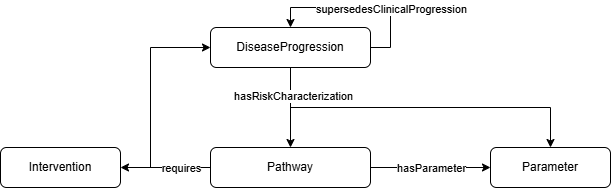
Pathways can define the risk itself (by means of the osdi:hasParameter property), but also extra requirements by means of the osdi:requires property.
For example, if you consider the BD_Proportion_Seizures_PBD defined in the parameters section, you may add an extra restriction
TTL Example (Pathway to seizures):
osdi:BD_Pathway_Seizures_PBD
    a owl:NamedIndividual , osdi:Pathway ;
    rdfs:label "Pathway to seizures PBD"@en ;
    osdi:hasDescription "A pathway to seizures in clinically diagnosed profound BD" ;
    osdi:hasParameter osdi:BD_Proportion_Seizures_PBD ;
    osdi:requires osdi:BD_ProfoundBD_Development .  # only individuals with the profound development may suffer seizures
Hence, instead of directly using the parameter, the manifestation would make reference to this pathway:
TTL Example (Modification of the manifestation to use the pathway):
osdi:BD_Seizures
    a osdi:AcuteManifestation ;
    rdfs:label "Seizures due to BD"@en ,
               "Crisis epilépticas debidas a DB"@es ;
    osdi:hasDescription "Acute seizures occurring in untreated or late-treated profound biotinidase deficiency, usually within the first year of life."@en ;
    osdi:hasRiskCharacterization osdi:BD_Pathway_Seizures_PBD .
Another useful feature to create more complex characterizations of the progression of a disease is the osdi:excludesDiseaseProgression property, that can be used from any osdi:DiseaseProgression individual. In the disease progression section, we presented an structured way of creating mutually exclusive disease progressions (osdi:AlternativeDiseaseProgressionSet). The osdi:excludesDiseaseProgression property is a more specific tool that allows for the creation of more sophisticated relationships.